Are Riftbound Cards a Real Investment?

The short version
- This is analysis, not financial advice — and the honest headline finding is that nobody has enough data yet to give real investment advice about Riftbound cards. Our own price tracking, which follows the game's most-traded singles, only goes back eleven days as of this writing.
- We can't tell you the 7-day or 30-day return, because those numbers don't exist yet. Not "we won't say" — the data literally isn't there. Neither window has enough price history behind it yet.
- What we can show you is real and current: which printings already carry genuine scarcity premiums (one card is worth 9× its twin for a single printed signature), how volatile a market this thin already looks, and exactly what it costs to buy and sell.
- If you already own cards and want to know what they're worth, that's a different — and answerable — question. Set a free price alert rather than guessing.
Type "are Pokémon cards a real investment" into a search engine and you'll find guides pulling on three decades of PSA grading volumes and named auction sales to answer it — Pikachu Illustrator, Charizard's climb, all of it dated, sourced, arguable but checkable.
Type the same question with "Riftbound" instead, and there's no honest way to answer it the same way. Not because we don't want to. Because the data doesn't exist yet.
That absence is itself the most useful thing we can tell you, so we're going to open with it rather than bury it, and then show you everything we actually can verify: today's real prices, today's real volatility, and today's real cost of doing business — none of which requires pretending we have a track record we don't.
Eleven days is not a track record
We track prices for a basket of 200 of the game's most-traded singles — the broad market data behind everything else on the site. The catch is how little history sits behind it.
Here's what that price data actually shows, as of this writing:
| Tracking began | 4 August 2026 |
| History so far | 11 days |
| Change since start | +11.6% |
| 1-day change | +0.4% |
| 7-day change | null — not enough history |
| 30-day change | null — not enough history |
That's not a rounding artifact or a display bug. It's the honest state of the underlying data: neither the 7-day nor the 30-day change can be computed at all yet, because neither window has completed. We could report "up 11.6%" as if it means something — plenty of sites would — but eleven days of a thinly-traded, brand-new market isn't a return, it's noise that hasn't had time to average out.
For scale: Riftbound has released five sets. The newest, Vendetta, came out on 31 July 2026 — two weeks before this article. We don't even have confirmed release dates for four of the other five sets in our own database, because Riot never published exact street dates for them. A market needs years to show whether an asset holds value; this one hasn't finished its first month.
What we can actually say, versus what we can't
| Riftbound cards (today) | S&P 500 | |
|---|---|---|
| Track record | 11 days of price data | ~100 years |
| Historical average annual return | Unknown — insufficient data | Roughly 10%/year nominal, long-run average |
| Minimum entry | Cents to low dollars for most cards | Fraction of a share via most brokers |
| Liquidity | Thin — see the spread example below | Extremely deep, sub-cent spreads |
| Typical selling cost | 2%–13.25%+ depending on venue | ~0.03%–0.20% fund expense ratio, or a few dollars in brokerage fees |
| Regulatory protection | None (unregulated collectibles market) | SIPC/regulator-backed depending on jurisdiction |
| Can the asset itself be banned/devalued by the publisher | Yes — has already happened once | Not applicable |
We're showing you this table specifically because half of it can't be filled in. That's the point. A guide that fills in "expected return" for Riftbound with a confident-sounding number is making it up. We'd rather show you an empty cell than a fabricated one.
Where the real value already sits: print scarcity
None of the above means nothing is measurable. Scarcity premiums between different printings of the same card are real, current, and easy to verify yourself — you don't need years of history to see that two otherwise-identical objects are priced differently today.
The clearest example in the whole game: Ahri, Nine-Tailed FoxUS$1.60, printed both with and without a Signature — the artist's actual signature, stamped across the art.
| Printing | Signature? | Live US price |
|---|---|---|
| OGN 303/298 | No | US$374.22 |
| OGN 303*/298 | Yes | US$3,420.28 |
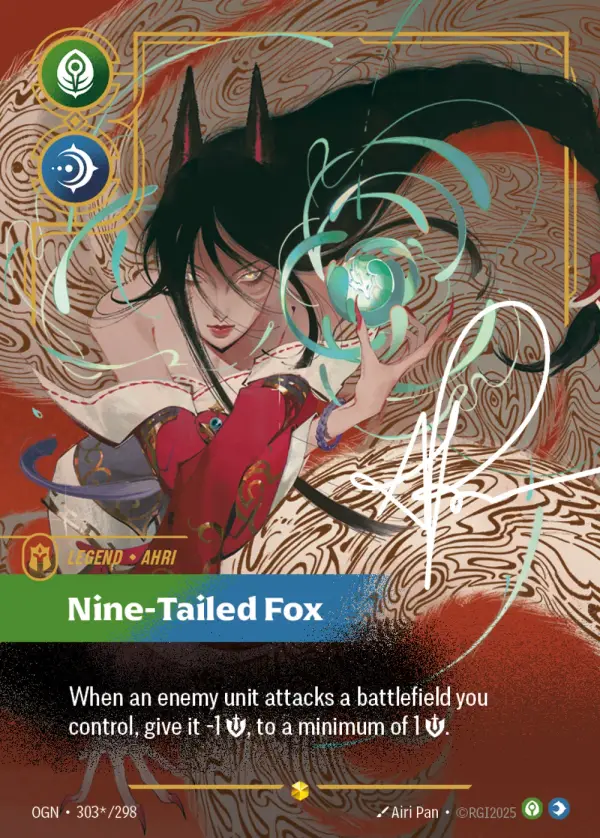
Same art, same rules, same rarity tier. The signature alone accounts for roughly US$3,046 of the difference — about 9 times the unsigned price. That's a real, observable, checkable fact about today's market. It is not a prediction about tomorrow's.
A second, sharper trap sits in the same data: promo status, which — unlike a Signature asterisk or an over-numbered collector number — leaves no visible mark on the number itself.
| Card | Number | Promo? | Live US price |
|---|---|---|---|
| Ahri, Nine-Tailed Fox | 255/298 | No | US$2.99 |
| Ahri, Nine-Tailed Fox | 255/298 | Yes | US$269.00 |
| Diana, Scorn of the MoonUS$0.24 | 197/219 | No | US$0.18 |
| Diana, Scorn of the Moon | 197/219 | Yes | US$1,899.99 |
The Diana pair is the extreme case: two cards, identical collector number, roughly 10,000 times apart in price, and the only difference is a promo flag you can't see by reading the number. If you're pricing anything more valuable than pocket change, check the listing's promo status specifically — the number alone won't warn you.
The cards named in this article
Every price above is live and checkable — click through to see every store selling each printing, in your own market.




What volatility looks like in a market this young
An 11-day-old, thinly-traded market is not going to behave like a mature one, and it doesn't. The daily volatility across the cards we track sits at 2.11% — for comparison, a mature equity index typically runs closer to 1% on an ordinary day. Of the 200 cards we track, 89 are up, 76 are down and 35 are unchanged as of this writing — nothing close to a one-directional market.
Individual cards move far harder than the aggregate. As of this writing, several of the cards we track have moved more than 100% in a week: Rhasa the SundererUS$1.65 (OGN 195/298) is up 415% over 7 days on a US$3.93 card, and multiple others are up well over 100% in the same window. These aren't chase cards — they're cheap ones, which is exactly the point: in a thin market, a handful of trades at a new price can swing the reported price enormously, in either direction, on cards worth a few dollars just as easily as on five-figure Signatures.
Liquidity friction shows up even inside a single day. Take Defy (OGN 045/298) — currently the listings for this one card, on the same day, in the same market, range from US$3.93 to US$11.00: nearly a 3x spread for the identical printing. That's not a typo or a stale listing; it's what "price discovery" looks like before a market has had time to converge. We deliberately track a broad, liquid basket of cards to smooth this kind of noise out of the overall picture — but the noise is still there in any individual card you might actually try to buy or sell.
What it costs to actually buy or sell one
Whatever the price on a card page says, it isn't what you'll net if you sell, and it isn't the last dollar you'll spend if you buy. Real numbers, by venue:
| Venue | Seller pays | Notes |
|---|---|---|
| eBay | ~13.25% final value fee | Charged on item price plus shipping |
| TCGplayer | Tiered commission + payment processing | Nets most sellers roughly 80–85% of sale price before shipping |
| Direct/local sale | 0% commission | No buyer protection either side |
None of that includes shipping, packaging, or — if you're selling across a border — currency conversion, which typically costs a further few percent depending on how you're paid. TCGplayer fees, explained in full and currency conversion costs both break these down further if you're weighing where to sell.
Grading: a separate market, not a multiplier
Riftbound doesn't have a centralised third-party grading body for raw card sales — the seller assigns the condition at the point of listing, based on their own judgement, which means the same physical card can be labelled differently by two different stores. Our condition guide covers what each grade actually means.
Third-party grading (PSA and similar) does exist for Riftbound's highest-value chase cards, but it's its own market, running on its own pricing logic, layered on top of the raw singles market rather than a fixed multiple of it. Don't assume a graded card is simply "raw price × some standard number" — check the graded market for that specific card directly.
A risk that doesn't exist for a closed collectible
Riftbound is an actively developed, competitively played game, which cuts both ways. The upside: it's built on League of Legends, one of the most-played games in the world, with a real organised competitive scene — UVS Games ran the most recent Regional Qualifier in Los Angeles in September, requiring a linked Riot Account to enter. That's genuine, ongoing investment in the game as a product, not just as a card set.
The downside: Riot can change the rules under you, and already has. On 24 July 2026, a week before Vendetta released, Riot banned three cards from Standard play — Stealthy PursuerUS$0.01 (over a documented infinite combo), The Arena's GreatestUS$0.13 and Aspirant's ClimbUS$0.10 — and introduced a separate ban list for Constructed 2v2 starting with Master Yi, Wuju Bladesman. A banned card doesn't vanish from existence, but it loses whatever demand came from being tournament-legal. That's a live-game risk that a closed, no-longer-printed vintage collectible simply doesn't carry, and it's worth weighing against any scarcity premium a card currently holds.
What we'd actually suggest
Not "buy" and not "don't." Three practical things that don't require a track record we don't have:
If you're buying: treat every purchase as buying a card you like, at a price you'd be fine never seeing again — because right now, nobody can tell you what it'll be worth later, including us. Compare the printing carefully (asterisk, over-numbering, and especially promo status) before you pay a premium.
If you're selling: run the real fee math before you list anywhere — eBay's ~13.25% final value fee versus TCGplayer's tiered commission is the difference between a good and a bad sale on the same card.
If you already own cards and just want to know what they're worth without checking daily: that's a genuinely answerable question, unlike the investment question. Set a free price alert and let the number come to you.
We built the price tracking, the price history, and the alerts specifically because we think a market this new deserves honest tools instead of confident-sounding guesses. We'll revisit this piece once there's actually enough history to say more.
Prices for cards in this post
- Ahri, Nine-Tailed FoxOrigins · 255/298US$1.60
- Diana, Scorn of the MoonUnleashed · 197/219US$0.24
- Rhasa the SundererOrigins · 195/298US$1.65
- Stealthy PursuerOrigins · 177/298US$0.01
- The Arena's GreatestOrigins · 290/298US$0.13
- Aspirant's ClimbOrigins · 276/298US$0.10
Cheapest in-stock price we track in your market, updated daily. Tap a card for every store.
Frequently asked questions
Are Riftbound cards a good investment?
Nobody can honestly answer that yet, ourselves included. Riftbound has released five sets, the newest of which is two weeks old, and our own price tracking only goes back to 4 August 2026. There is no multi-year track record to point to, up or down. What we can tell you is what the market looks like today: real prices, real fees, real volatility. Whether today's prices look smart in five years is not something the data can answer yet.
What actually makes a Riftbound card valuable right now?
Print scarcity, almost entirely. A Signature printing (marked with an asterisk in the collector number) or an over-numbered chase print can be worth many times its plain twin — Ahri, Nine-Tailed Fox goes from US$374.22 unsigned to US$3,420.28 signed, identical art and rules. That's a real, observable premium for scarcity today. It is not evidence that the premium will still be there next year — nobody has owned these long enough to know.
What fees will I actually pay if I sell a Riftbound card?
It depends where you sell. eBay's final value fee for trading cards is commonly around 13.25%, charged on the total including shipping. TCGplayer charges a tiered marketplace commission plus separate payment processing, netting most sellers somewhere in the low-to-mid 80% of the sale price before shipping costs. A direct trade or local sale avoids commission entirely but gives up buyer protection.
Can a Riftbound card lose value overnight through no fault of the card?
Yes, and it's already happened. On 24 July 2026, Riot banned three cards from Standard play — Stealthy Pursuer, The Arena's Greatest and Aspirant's Climb — and introduced a separate ban list for Constructed 2v2. A card that's competitively banned doesn't stop existing, but it loses the demand that comes from being playable, which is a risk that doesn't exist for a closed, no-longer-published collectible like a vintage trading card.
Ready to buy?
Free price alerts across every store we track — the honest alternative to guessing whether now is the time to sell.